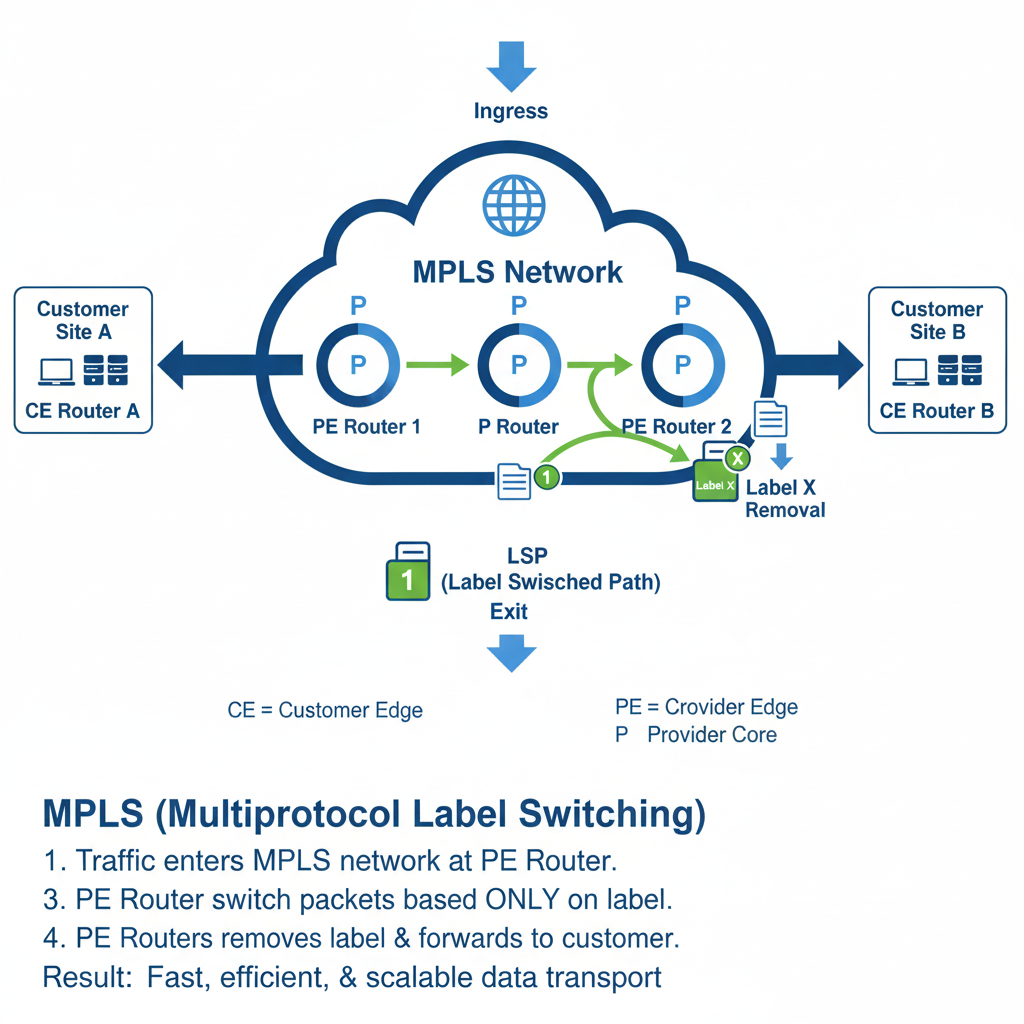




In modern-day, fast-paced Indian corporate life, timely and high-performance network connectivity is not a luxury but the key to success in operations. You are either a bank with branches scattered across the land, a manufacturing facility with geographically distributed factories, or a big e-commerce player – your capacity to carry real-time voice, data, and video traffic securely and reliably in a consistent manner is critical. Enter MPLS (Multiprotocol Label Switching) as the underlying technology.
What is MPLS, Exactly?
MPLS is a robust, label-based method of routing network traffic. Consider normal internet traffic to be a postal system where each letter (data packet) has to be read at each post office (router) to figure out what to do next on its lengthy trip, which creates delays.
MPLS totally turns this on its head. It establishes pre-defined, virtual express routes across the network. When a data packet is passed into the network, it’s given a short, easy-to-understand label. Routers along the route simply read this label—like an express ticket—to push the packet along rapidly and efficiently, without the need for a time-consuming address lookup at each and every hop.
This mechanism guarantees:
Faster Data Delivery: Lower latency is essential for services such as Voice over IP (VoIP) and real-time trading exchanges.
Predictable Performance: Data always takes the shortest and most direct pre-defined path.
The Key Benefits to Indian Businesses
For today’s Indian companies with multi-location businesses, MPLS provides a number of key benefits that directly map to improved business results:
- Guaranteed Quality of Service (QoS)
MPLS’s most appealing aspect is its capacity to assign greater priority to specific types of traffic. You may have mission-critical information, voice calls, and plain email all in one corporate network.
MPLS enables the network to prioritize real-time applications such as video conferencing or core banking transactions at a high level, so they have the bandwidth and low latency they require even during busy times.
Less-priority traffic, such as congestion or system updates, utilizes the capacity not taken up by critical applications. This kind of traffic prioritization is critical to ensure productivity and customer satisfaction in all branch offices.
- Improved Network Security and Privacy
MPLS networks are essentially a Virtual Private Network (VPN) service over a carrier’s infrastructure. This offers a safe and isolated platform for your corporate traffic.
Your packets of data follow predetermined routes that are divided and isolated from the general public internet traffic. Such segregation provides higher security levels than transmitting sensitive corporate information over the open internet. To industries such as defence, finance, and healthcare, such private networking is not an option.
- Scalability and Reliability for Distributed Operations
When a company grows from city to city and state to state, its Wide Area Network (WAN) has to expand smoothly.
MPLS is scalable by design, enabling you to introduce new branch offices, warehouses, or remote sites without complicated network redesigns.
In addition, MPLS network providers incorporate redundancy and automatic failover features. That is to say that if a problem occurs on one path, traffic is routed virtually immediately along a reserved alternate express route, providing near-constant network uptime and business continuity.
MPLS and the Cloud-First Future
While emerging technologies such as SD-WAN are becoming increasingly popular, MPLS is an essential, high-performance solution, commonly co-existing in a hybrid setup. Most progressive Indian businesses now employ the Hybrid WAN strategy:
MPLS as the high-priority, dedicated, and most reliable high-bandwidth backbone for mission-critical traffic and data centre communications.
Lower-cost broadband internet is placed over this backbone for non-critical, flexible traffic such as guest Wi-Fi or general web browsing, all handled smartly by today’s networking solutions.
In conclusion, for those companies that need constant low-latency and assured performance for their primary applications, MPLS is the tried-and-true foundation. It enables the secure, high-speed links required to accommodate an enterprise-level digital experience, ultimately ensuring that India’s modern business operations successfully run with ease, reliability, and efficiency.